The world’s first and only skills library connecting academia, applicants, and industry
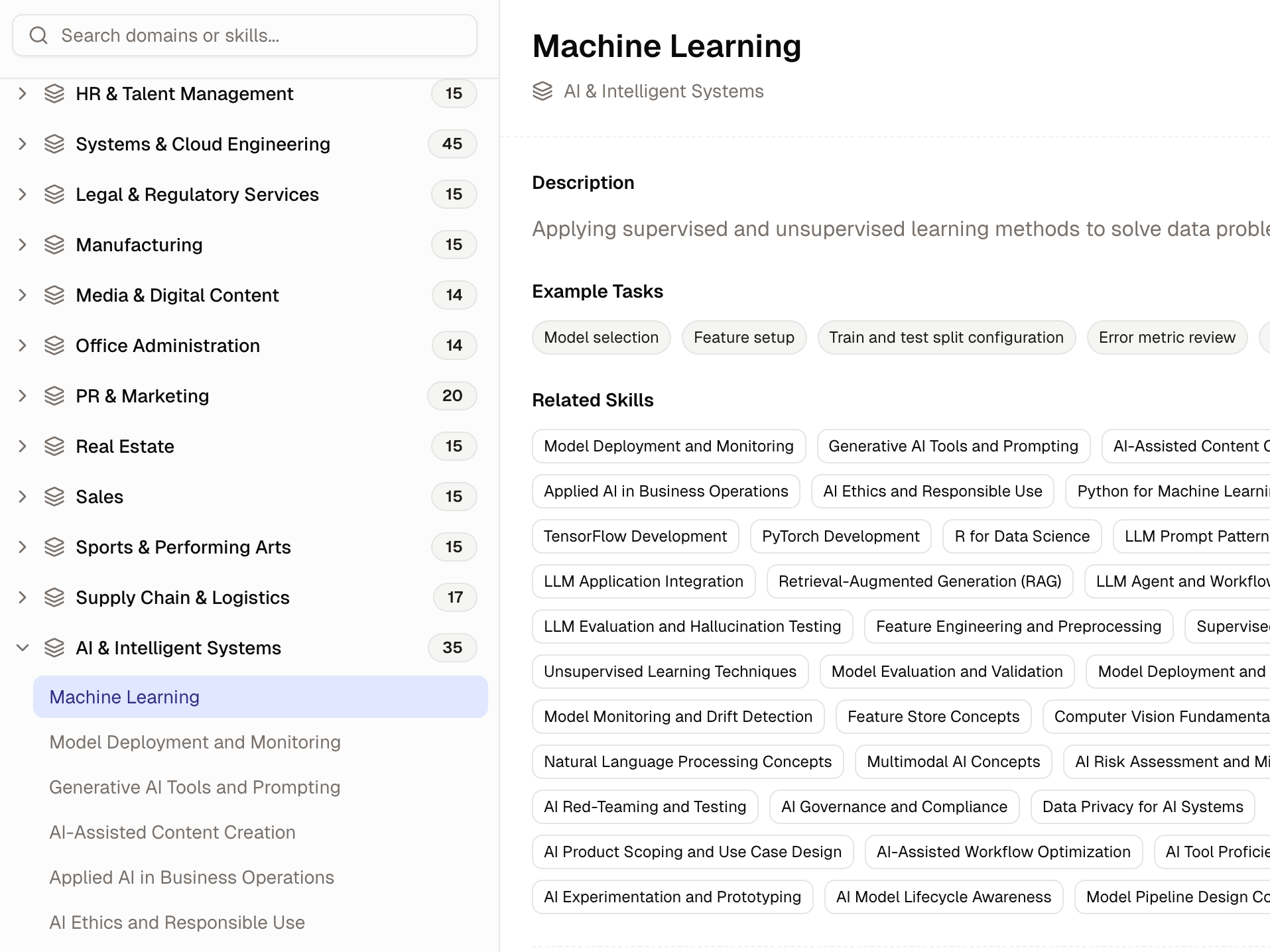
A continuously evolving skills taxonomy built from real-world signals. New skills emerge as they appear in job descriptions, the library stays intentionally right-sized for precision and comparability, and every skill is aligned across syllabi, resumes, and roles.
Skills are everywhere - but they don’t mean the same thing
Higher education, applicants, and employers all talk about skills, but they use different vocabularies, levels of detail, and definitions. Programs describe learning outcomes, resumes reflect experience, and job descriptions signal real-time demand. Without a shared skills foundation, these artifacts can’t be compared or aligned. Traditional frameworks fail by being either too large and fragmented to stay precise, or too small and static to keep up with how work actually changes.
- Skills aren’t comparable across education, resumes, and jobs
- Skills frameworks are either too broad or too narrow to be useful
- New skills emerge faster than static taxonomies can adapt.
- Skills appear aligned on paper but fail in real analysis.
Making Skills Comparable in Practice
Skills are discovered from real-world signals, deduplicated and curated to stay right-sized, and aligned across education, applicants, and industry so they can be compared with confidence.
Discover skills from real-world signals
We analyze syllabi, resumes, and job descriptions to identify how skills are taught, applied, and demanded in practice.
Deduplicate and normalize skills
Overlapping and synonymous skills are consolidated into a single, consistent definition to eliminate noise and fragmentation.
Right-size the skills library
Skills are curated to avoid taxonomies that are too broad to stay precise or too narrow to remain comparable.
Align skills across all artifacts
Each skill is consistently mapped across education, applicants, and roles so skills can be reliably compared and measured.
What You Can Do with the Skills Library
Use a shared, right-sized skills foundation to analyze programs, compare talent, and understand workforce demand with confidence.
Compare skills across artifacts
Analyze and compare skills consistently across syllabi, resumes, and job descriptions.
Track emerging skills
See new and evolving skills as they appear in the labor market, not months or years later.
Align education with demand
Understand how academic programs map to real-world skill requirements and roles.
Unlock career pathways
Connect applicants to relevant jobs, upskilling opportunities, and transitional skills needed to move into new roles or industries.
The Foundation Behind Every Skill-Driven Insight
Concrete, reusable outputs that turn a shared skills foundation into insight, alignment, and action across education, talent, and workforce use cases.
Canonical Skills Library
A deduplicated, continuously maintained catalog of skills with consistent definitions, domains, and aliases.
Skill Domains and Structure
A right-sized domain structure that balances precision and comparability across use cases.
Cross-Artifact Skill Mappings
Standardized mappings that align skills across syllabi, resumes, and job descriptions.
Transitional and Adjacent Skills
Explicit identification of transferable skills and gaps needed to move between roles or industries.
Exportable Skills Data
Clean, structured skills outputs ready for reporting, audits, analysis, and downstream workflows.
Integration-Ready Skill Objects
Normalized skill entities designed to power matching, alignment, and embedded experiences.
A skills foundation you can trust
Built from real-world signals and continuously maintained so skills stay consistent, deduplicated, and comparable across education, applicants, and industry.
See the Skills Library in action
Book a demo to see how a shared, right-sized skills foundation enables meaningful comparison and alignment across education, applicants, and industry.