
Build Employer-Backed Credentials That Guarantee Day-One Readiness
Stop guessing what corporate partners want. Co-design programs using real-time skills data and localized labor demand to guarantee total market relevance before a single student enrolls.
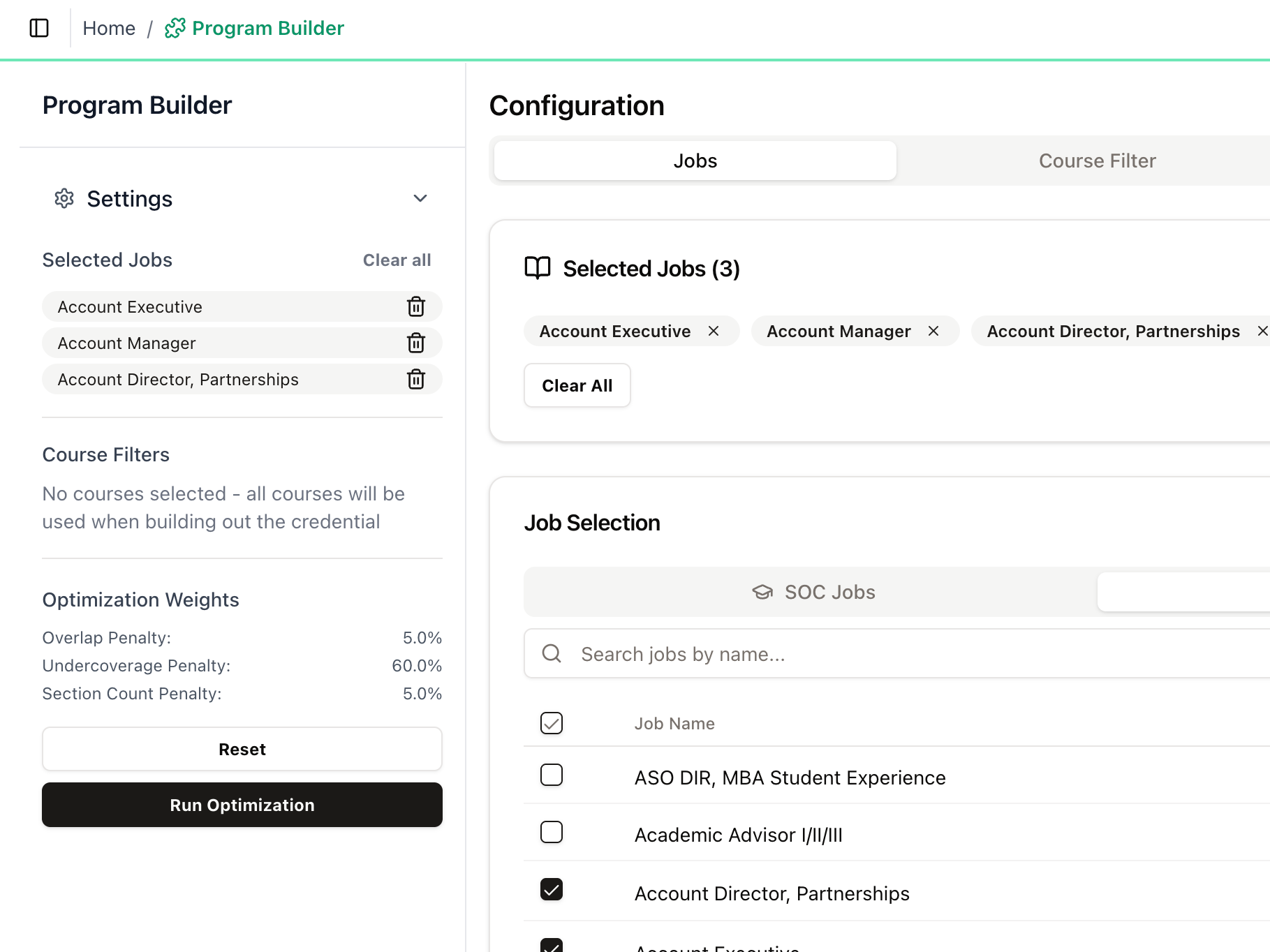
- Translate target jobs into structured skill requirements
- Map existing courses to employer-defined skills
- Identify gaps before finalizing the credential
- Validate regional demand and wage context
- Launch with employer alignment built in
Bridge the Gap Between Your Classrooms and Their Boardrooms
In corporate partnerships, the institution is committing to an outcome: a credential that maps to real roles, real skill requirements, and real hiring demand - before anything is launched.
Dean or workforce program director
Meeting with a corporate partner to define a new credential
“Target job titles and role expectations from the employer, a set of existing courses and certificates, and early questions about what must be included to meet hiring needs.”
- Clarify the roles the employer is hiring for
- Translate role expectations into concrete skill requirements
- Identify which existing courses cover those skills
- Spot what is missing and what is redundant
- Validate regional hiring demand and wage context
Curriculum and employer roles are not speaking the same language.
Employers describe roles in job postings. Institutions describe learning in course catalogs and syllabi. Both are trying to describe capability - but without translating that capability into skills, alignment remains manual and subjective.
- Job descriptions list responsibilities, not structured skill requirements
- Course catalogs describe topics and credits, not normalized skill coverage
- Alignment discussions rely on interpretation instead of comparable evidence
- Gaps and redundancies are identified manually
- Hiring demand and wage context are reviewed separately from curriculum design
Design the credential in the language of skills.
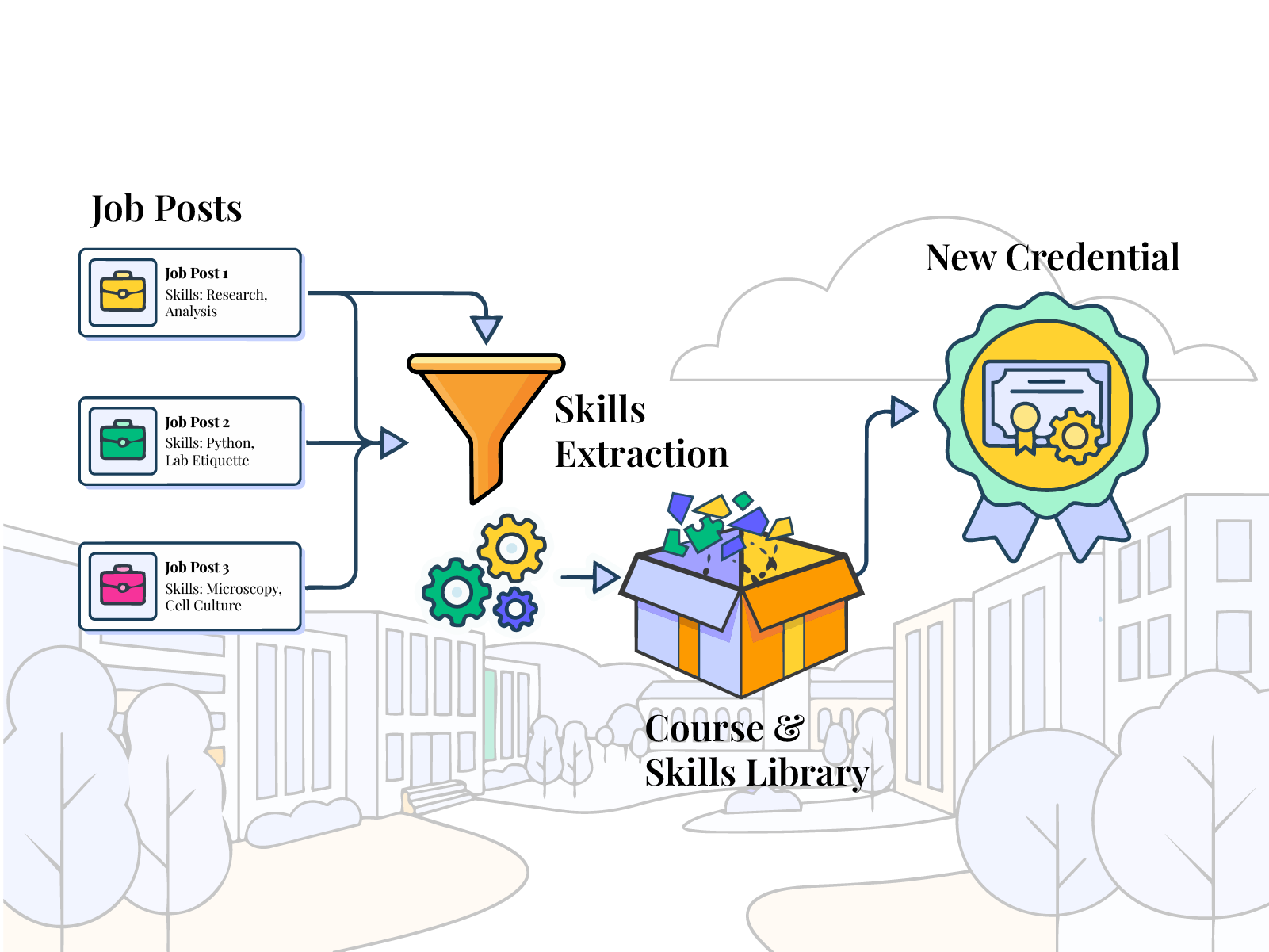
Mapademics translates both employer roles and curriculum into skills - so alignment, gaps, and coverage are visible before launch.
Translate target roles into skills
Employer job postings and role descriptions are analyzed and normalized into structured skill requirements.
Role-to-skill extraction and normalization
Stop interpreting job descriptions and start seeing the actual skill requirements.
Anchor in labor demand
Regional job volume, growth, and wage data are connected to the target roles.
Live job and labor market intelligence
The credential is grounded in real market demand, not anecdote.
Translate curriculum into skills
Course catalogs and syllabi are analyzed and mapped to structured skill coverage.
Curriculum skill extraction and coverage mapping
See what the program actually teaches in skills.
Assemble the optimal credential
The best collection of courses is identified to cover the required skills with minimal gaps or redundancy.
Skills-based credential builder
Design the credential intentionally around skills, not around legacy structures.
Launch with documented alignment
The proposed credential is backed by documented skills alignment and labor demand context.
Employer-ready alignment report
Alignment is documented before launch - so both employer and institution can stand behind it.
Walk into the partner meeting with documented alignment.
A skills-based credential proposal showing exactly how the program maps to employer roles, hiring demand, and required skills - before anything is launched.
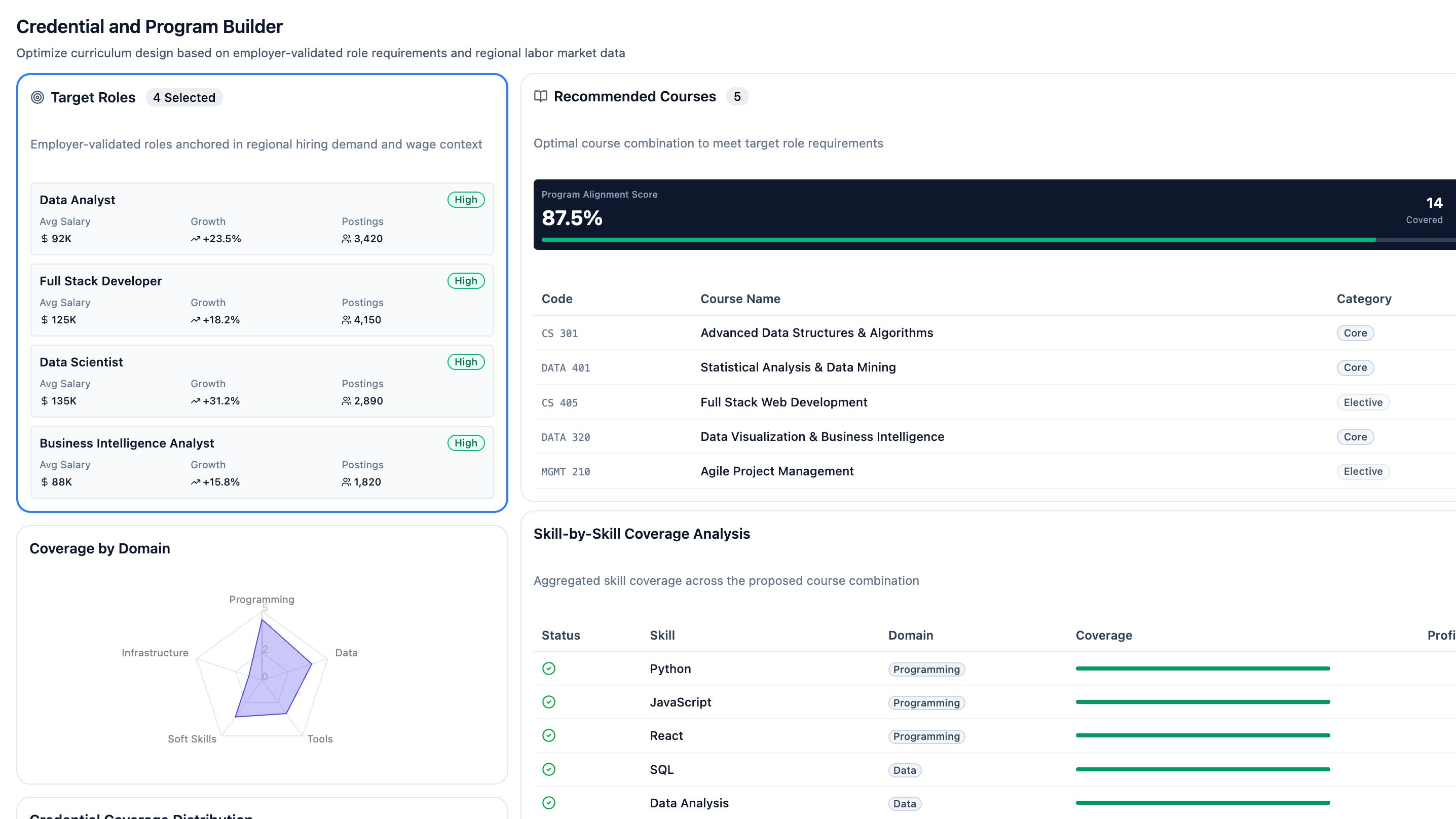
- 1Target Roles
Employer-validated roles anchored in regional hiring demand and wage context.
- 2Domain Coverage
Aggregated domain coverage across the proposed course combinations.
- 3Alignment Score
Clear percentage match between required skills and program coverage.
- 4Documented Skills Coverage
Explicit list of covered skills and attainment levels
Powered by the Mapademics skills platform.
Behind the credential builder is a skills infrastructure that translates roles and curriculum into comparable, defensible evidence.
Matching & Alignment
Compare employer skill requirements and curriculum coverage directly at the skill level.
Matching & AlignmentLabor Market Intelligence
Anchor credential design in regional demand, growth projections, and wage context.
Labor Market IntelligenceLive Job Intelligence
Extract required skills directly from live job postings and employer role definitions.
Live Job IntelligenceProgram & Credential Builder
Design credentials intentionally around skill requirements before launch.
Program & Credential BuilderValidate your next credential before you launch it.
Bring one employer partnership and one proposed credential. We’ll show you exactly how it aligns - and where it doesn’t - in your region.