
Evidence-Backed Transfer Articulation & Course Equivalencies
Automate and standardize transfer decisions using skills, whether you’re matching from transcripts and catalogs or conducting full syllabus-based articulation. Move from manual interpretation to structured, defensible equivalency.
- Match courses using catalog and transcript data alone
- Enable deeper syllabus-based articulation when available
- Generate defensible equivalency justifications automatically
- Produce committee-ready reports with course level justifications
- Scale articulation agreements across institutions or systems
Transfer review is a repeated, manual, and time-consuming process.
Transfer administrators apply expert judgment to determine course equivalency. Yet the process forces them to repeat the same manual work each time - reviewing transcripts, interpreting catalogs, and documenting the rationale behind their decision.
Transfer administrator
Preparing course equivalency decisions ahead of a committee review cycle.
“A student transcript, course titles and credit hours, an external institution’s catalog, and sometimes limited or no access to syllabi.”
- Locate and download the sending institution’s catalog
- Compare course descriptions manually
- Interpret credit level and scope differences
- Request syllabi when descriptions are insufficient
- Write justification notes for each proposed match
Transfer decisions are not built on reusable infrastructure.
Course equivalency is determined through manual comparison of descriptions, credits, and levels. Each decision is documented individually. There is no shared framework that structurally connects curriculum across institutions, so equivalencies must be reinterpreted for every student, program, and review cycle.
- No structured, comparable representation of course content
- Equivalencies are documented case by case rather than systemically
- Catalog-only matches rely on narrative interpretation
- Syllabus-based articulation requires separate manual review
- Institution- or system-level agreements require repeated rework
Turn transfer review into a structured, skills-based process.
Whether working from transcripts and catalogs or full syllabi, skills provide a common framework for defensible, scalable equivalency.
Translate courses into skills
Courses from both institutions are translated into structured skills profiles using catalog descriptions or full syllabi.
Catalog-based and syllabus-based skills extraction
Course comparison moves from narrative interpretation to structured alignment.
Compare courses objectively
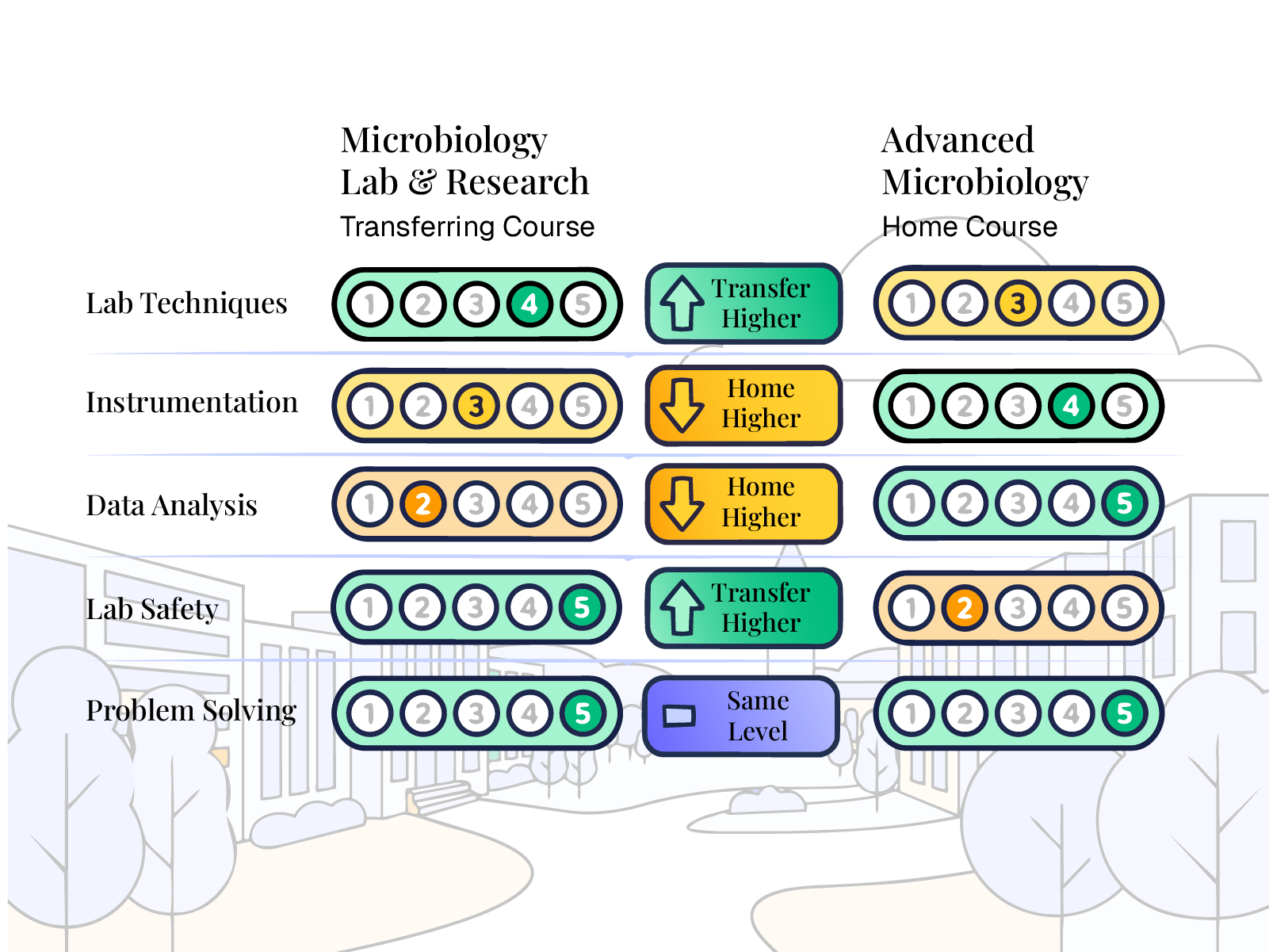
Skills profiles are compared to identify overlap, depth, and missing coverage.
Skills-based course equivalency matching
Equivalency decisions are grounded in visible, comparable criteria.
Generate defensible justification
For each proposed equivalency, a structured justification is produced automatically.
Committee-ready equivalency reporting
Committee review shifts from rewriting narrative explanations to reviewing structured evidence.
Reuse decisions across students
Approved equivalencies are stored and applied consistently across future transfer cases.
Reusable transfer decision infrastructure
Transfer work compounds instead of restarting for every student.
Standardize articulation at scale
Institutions or systems can formalize articulation agreements using a shared skills framework.
System-level articulation standardization
Transfer becomes consistent, transparent, and scalable across institutions.
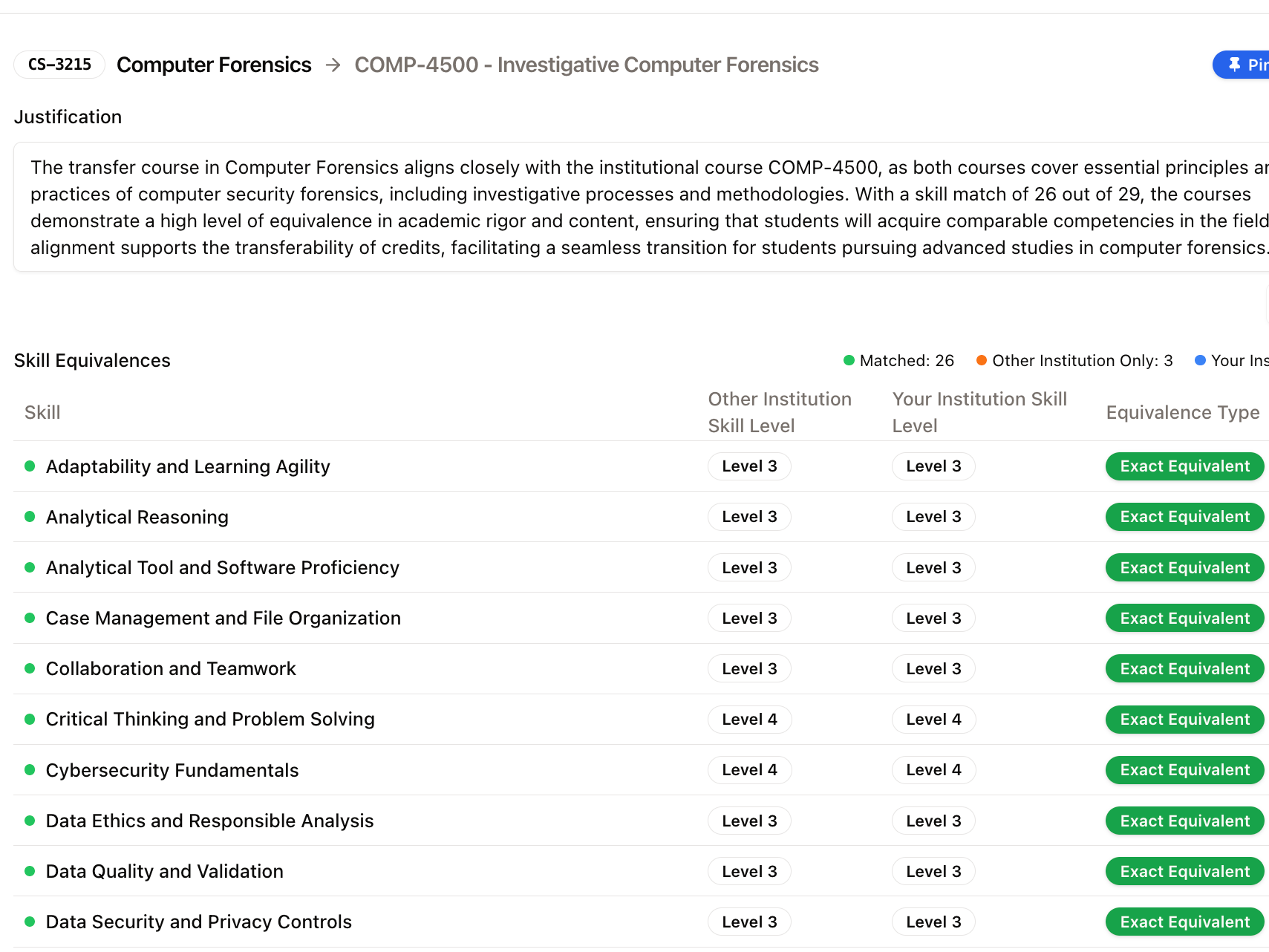
A structured course equivalency report ready for approval.
Each proposed match includes skills alignment, overlap analysis, and a clear justification summary for committee approval.
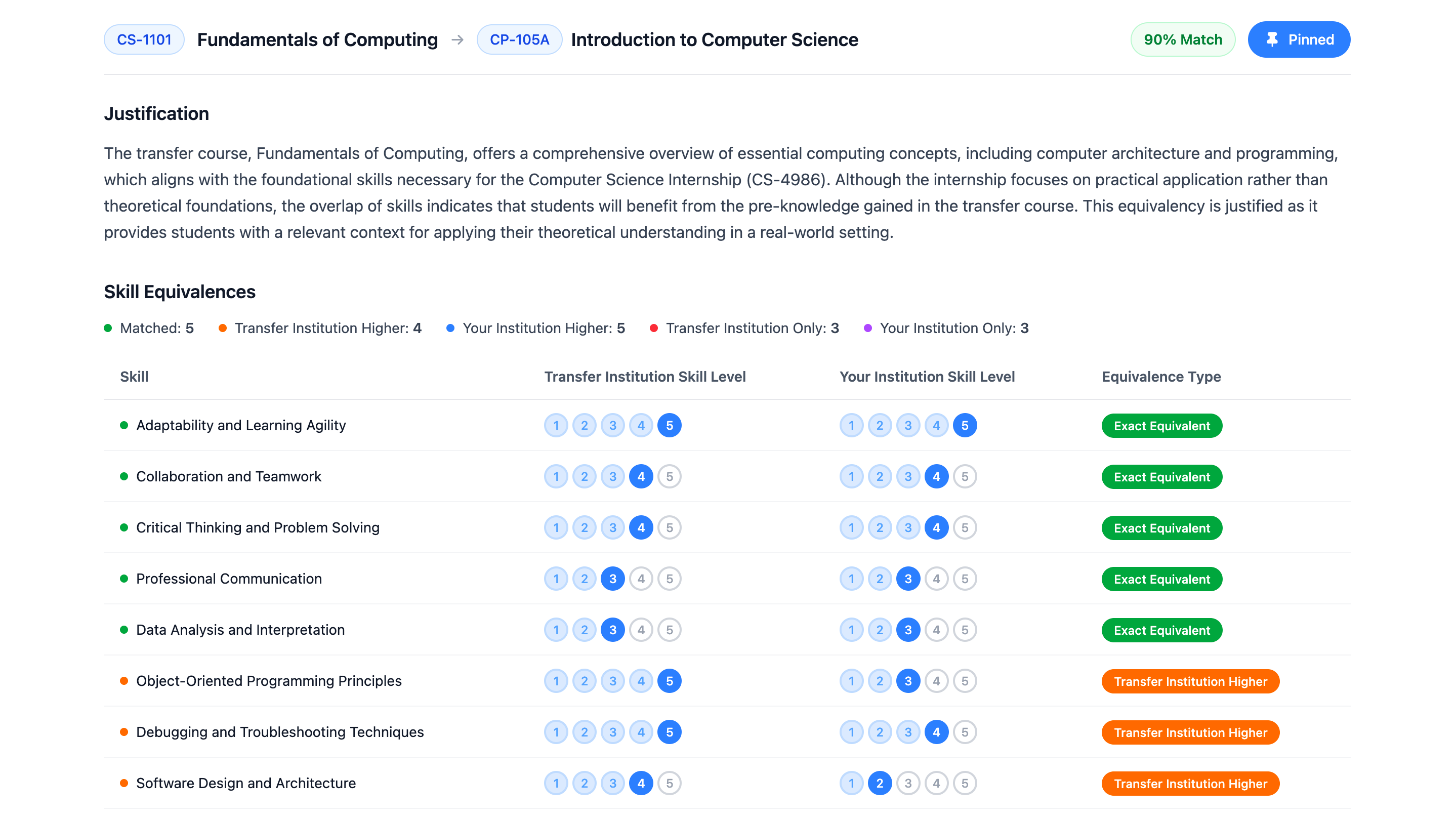
- 1Alignment Score
At-a-glance objective comparison score
- 2Skills overlap analysis
Shared skills and attainment levels highlighted
- 3Decision justification
Proposed equivalency completed with an automated justification
See the infrastructure behind skills-based transfer.
From catalog-only matching to syllabus-based articulation and reusable agreements, explore the components that power structured transfer decisions.
Skills Extraction & Translation
Translate catalog descriptions or full syllabi into structured, comparable skills profiles.
Skills Extraction & TranslationMatching & Alignment
Compare courses objectively using shared skills and alignment criteria.
Matching & AlignmentSkills Intelligence Workspace
Store approved equivalencies and standardize articulation across programs or institutions.
Skills Intelligence WorkspaceTransfer & Articulation
Automate course matching, generate committee-ready reports, and scale agreements system-wide.
Transfer & ArticulationMake transfer defensible, reusable, and scalable.
See how catalog-only matching and syllabus-based articulation can become structured, skills-based infrastructure across your institution.