Coursedog Launches Labor Market Insights - Powered Exclusively by Mapademics
What Coursedog actually built (and why it matters)
Coursedog — the Intelligent Academic Operations Platform serving 400+ campuses and 3.3M+ students — has officially launched Labor Market Insights. It is a fully native product that embeds real-time labor market data — employment, occupational outlook, median salary, in-demand skills, alternative job titles, and regional filters — directly into curriculum proposals, program records, and public catalogs.
It is powered exclusively by the Mapademics API.
Coursedog is now the first curriculum vendor with a fully native, embedded labor market experience. No third-party widgets. No clunky plugins. No separate logins. No "click here to open the dashboard." Just one click inside the workflow your customers already use.
We helped Coursedog ship the first iteration in under three months, and it shipped to every Coursedog customer on day one — not as a premium SKU, not as a pilot, not as a roadmap promise.
The first release surfaces labor market data inside the curriculum lifecycle. The Mapademics API exposes much more: skills extraction, syllabus-level skills mapping, program-to-occupation alignment, course equivalency analysis, and live job intelligence — all of which Coursedog (and you) can layer on next.
The same APIs that powered the Coursedog launch are available to your product today. So is our pre-built embeddable widget if you'd rather skip development entirely.
What Coursedog actually built (and why it matters for the category)
For years, "connecting curriculum to careers" has been a slide in every higher-ed product roadmap and a real outcome in almost none of them. The pattern was always the same: a catalog vendor or a curriculum vendor would gesture at workforce data, then redirect users to a separate dashboard. Separate login. Separate vendor. Separate invoice. Separate procurement cycle.
Coursedog broke the pattern.
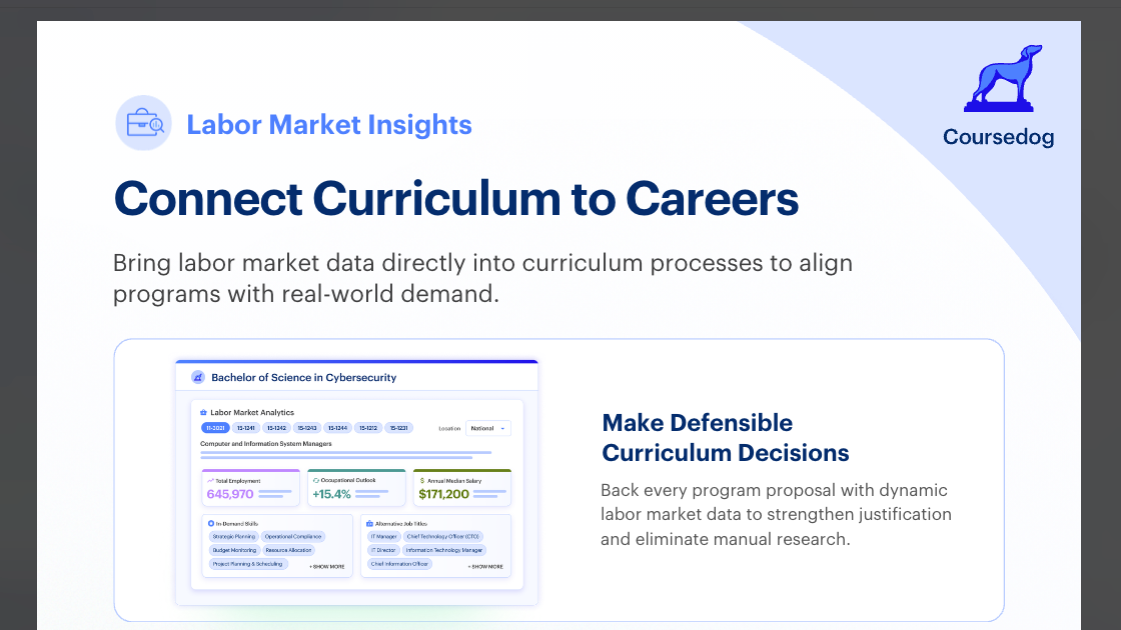
The first iteration of Labor Market Insights, live this May, puts live labor market data into the three highest-leverage surfaces in the entire curriculum lifecycle:
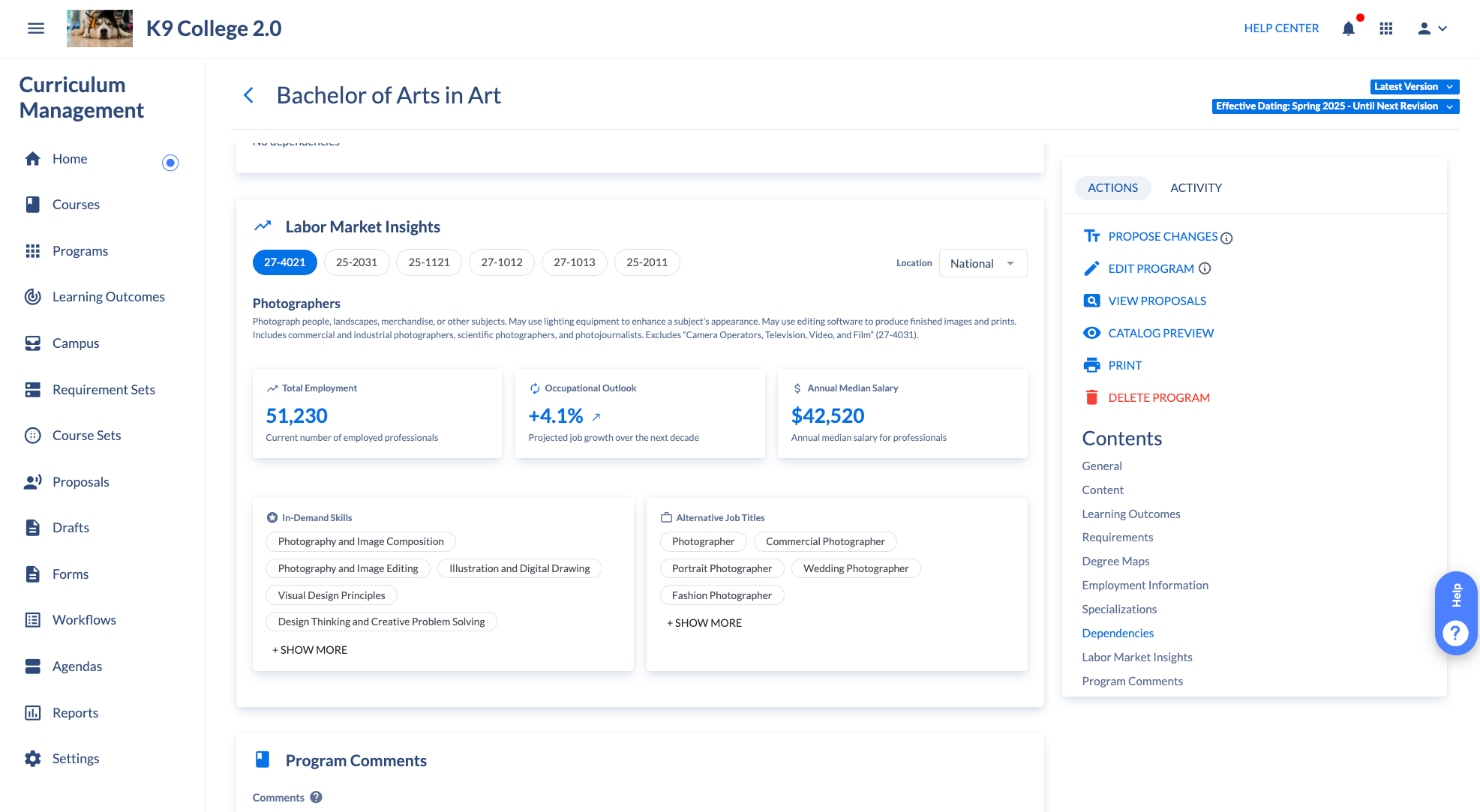
- Inside program proposals — curriculum committees see total employment, occupational outlook percentages, median salary, in-demand skills, and alternative job titles for matched SOC occupations, right inside the proposal they're voting on.
- Inside program records — the same labor market context is available on the underlying program, filterable by location (national, state, metro, or city). The conversation moves from "I think this is in demand here" to "here's exactly what this region is hiring for."
- On public catalog pages — prospective students see real career outcomes — employment numbers, median salary, related occupations — on the program page itself, at the exact moment they're choosing what to study.
It looks like Coursedog. It behaves like Coursedog. It lives where the work already happens. Under the hood, every piece of that data is a Mapademics API call.
That's the bar the category just moved to.

What's next on the Coursedog roadmap (and what the API already supports)
The first release intentionally focused on the highest-leverage move: getting labor market data in front of the people making curriculum decisions, and the students making program decisions. Coursedog's team has a much bigger roadmap planned on top of the Mapademics API — and we're powering all of it.
Capabilities already live in the API that Coursedog and other partners can build on next:
- Skills extraction from syllabi and course descriptions — turn unstructured curriculum content into structured skills profiles, automatically.
- Program-to-occupation alignment with transparent evidence — show why a program maps to a given occupation, skill by skill, defensible to a curriculum committee or an accreditor.
- Course-level skills mapping — connect individual courses to specific labor market skills, supporting micro-credentialing, stackable credentials, and curriculum gap analysis.
- Course equivalency analysis — compare courses across institutions or against employer skill requirements; the foundation for transfer articulation and credit-for-prior-learning workflows.
- Live job intelligence — beyond aggregate labor market signals, surface specific employers, postings, and emerging skills in real time.
- Custom job feeds — institutions can upload localized job postings to align programs to specific regional employers, including private datasets and partner employer networks.
Coursedog now owns the foundation. Everything above is on the table for what they (or you) build next — on the same API that already powers what's live today.
Why this matters if you build software for higher education
Higher-ed institutions are under real pressure right now. According to the Burning Glass Institute and Strada Education Foundation's Talent Disrupted, only about half of bachelor's degree graduates are working in a college-level job a year after graduation, and 45% are still underemployed a decade later. Meanwhile, the share of U.S. employers using skills-based hiring jumped from 57% in 2022 to over 80% by 2024, with the trajectory still climbing (SHRM via Testlify). The framework provosts, registrars, deans, and trustees are being evaluated on has fundamentally shifted.
They're all being asked the same question by their boards and their state legislatures: what evidence do we have that this program leads somewhere?
Your customers are getting that question. If your product touches curriculum proposals, catalog publishing, program review, advising, transfer articulation, assessment, or student-facing program discovery, you are sitting on the surface area where this question gets answered. Or doesn't.
Mapademics is the layer that lets you answer it — and grow into deeper skills intelligence over time, the same way Coursedog is doing.
Two ways to put labor market intelligence inside your product
Option 1 — The Mapademics API (what Coursedog chose)
For teams that want a fully native experience, the API gives you programmatic access to the full Mapademics data layer:
- Labor market data — employment, occupational outlook, median salary, in-demand skills, alternative job titles, filterable by region, state, metro, or city (the layer Coursedog is using today).
- Skills extraction & translation — turn a course description, syllabus, or program record into a structured skills profile.
- Program-to-occupation mapping — match programs to standardized SOC occupations with transparent, defensible evidence.
- Skills library access — the same taxonomy used across the Mapademics platform, so your data stays consistent with everyone else in the ecosystem.
- Live job intelligence — active job posting signals, employer-level demand, and emerging skill trends.
You don't have to use all of it on day one. Coursedog didn't. They started with the labor market data layer that delivered the most immediate value to their customers — and have the rest available as their roadmap unfolds. Your integration can follow the same pattern.
From kickoff to production launch on the Coursedog engagement: under three months. Available to every customer on day one, with no per-school configuration required.
Option 2 — The Mapademics Embed Widget
If you'd rather not build, our pre-built widget is already compatible with all major catalog websites and content management platforms. No-code embed. Branded to match your product. Drop in a script tag, point it at a program, and students see career outcomes immediately.
The widget is the fastest path to market — typically days, not months — and it works whether you're a catalog vendor, a CMS, a student portal, a CRM, an advising tool, a job board, or a workforce platform.
Who this is for
- Catalog and curriculum vendors competing in the same RFPs where workforce alignment is now a required line item
- SIS providers looking to add a high-value layer to their existing footprint without disrupting the system of record
- Student-facing platforms (program discovery, advising, transfer, recruitment marketing) that need career outcomes to be more than a brochure
- Workforce, CTE, and continuing education platforms that need to translate between training content and employer demand
- CRMs and recruitment platforms that want prospective students to see real outcomes during the funnel, not after the deposit
- Career services and job boards that want to close the loop between coursework and roles students can actually get
If your customer is a college, university, system office, or workforce board, labor market intelligence is becoming table stakes. The vendors who embed it natively will win the renewals.
What our partnership with Coursedog proves
Four things worth pulling out for anyone evaluating Mapademics as a partner:
- Speed. Under three months from contract to live in production, available to every Coursedog customer.
- Depth. Not a tab. Not a sidebar. Embedded in the proposal workflow, the program record, and the public catalog — the three highest-leverage surfaces in the curriculum lifecycle.
- Scale. Coursedog serves 400+ campuses. The same Mapademics infrastructure powering their rollout is what we'd put behind yours.
- Headroom. Coursedog shipped the first iteration on a fraction of what the API offers. The path from "labor market data embedded in the catalog" to "skills extraction, program-to-occupation alignment, and live job intelligence woven through the whole curriculum lifecycle" is paved on the same API — and the same will be true for your product.
This is the first of many integrations we're announcing this year. Coursedog has a roadmap of features they're already building on top of our API. We expect to be doing the same with several more partners across the ecosystem in the coming quarters.
Let's talk
If you're a vendor and any of this resonates — whether you want the full API, the embed widget, or just to compare notes on where skills and labor market data fit into your roadmap — we'd love to start a conversation.