
Transfer Articulation and Workforce Alignment Are the Same Problem
States and systems buy transfer software from one vendor and labor market data from another. They are two halves of a single translation problem — and solving them separately is why neither one works well.
A student finishes two years at a community college, transfers, and watches roughly two of every five credits disappear. The U.S. Government Accountability Office put the average credit loss at 43 percent. About a third of undergraduates transfer at least once, and more than 43 million Americans — nearly 38 million of them under 65 — now hold college credit with no credential to show for it.
Now ask that same student a second question: of the credits that did transfer, which ones make them employable? Almost nobody can answer. That question belongs to a different office, a different budget line, and usually a different vendor.
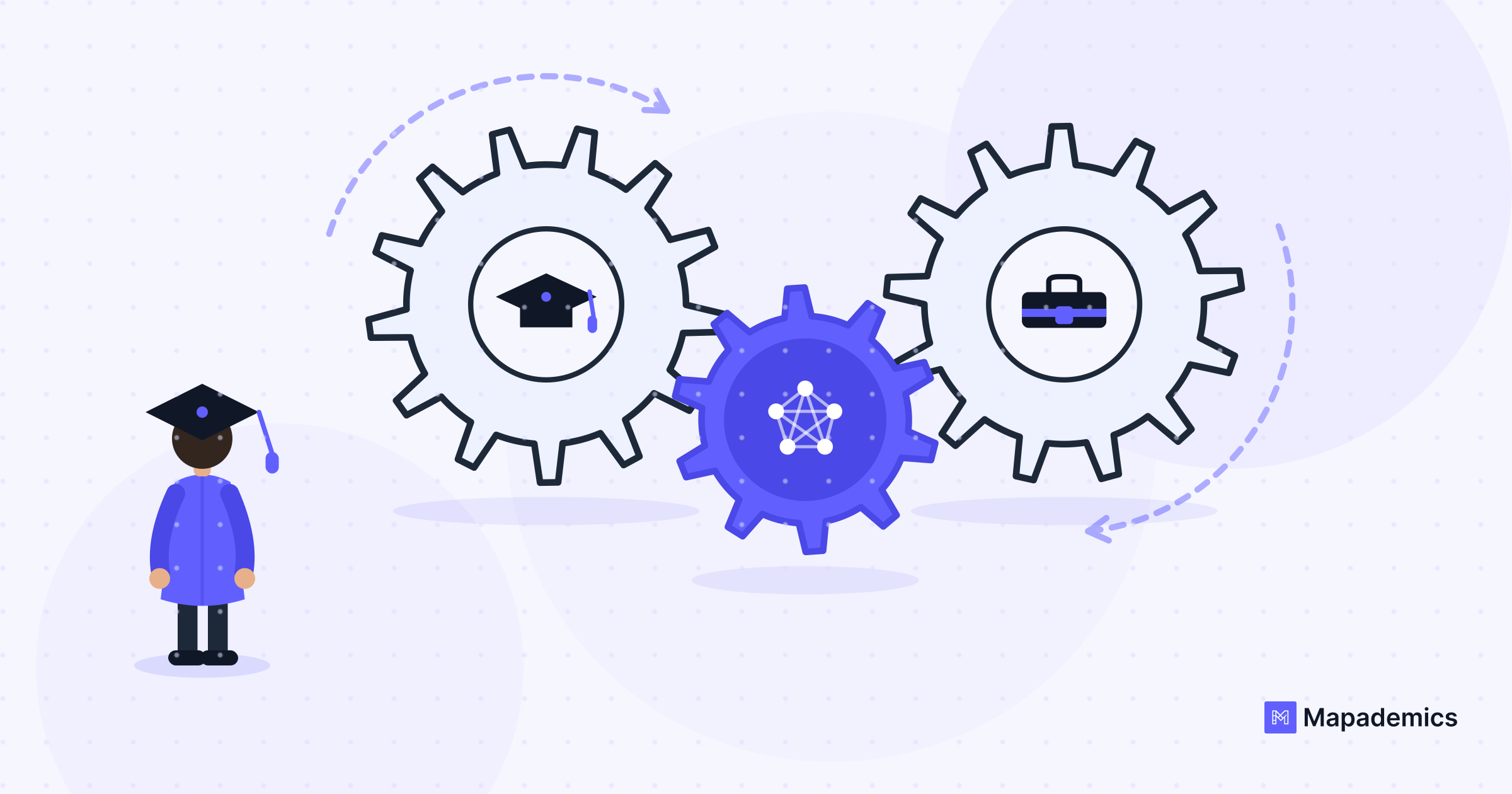
It should not. Transfer articulation and workforce alignment are not two problems. They are one problem with two destinations.
Curriculum is written to be internal. Then it has to travel.
Colleges build curriculum carefully and locally. Faculty design a course, a committee reviews it, a catalog describes it. All of that is optimized for one institution's internal coherence — and it works.
The breakdown happens the moment coursework has to leave the building: to another institution, across state lines, or into the labor market. Those look like three journeys. Structurally they are one — something learned in one context has to be recognized in another, by people who were not in the room when it was designed.
The language we use for that translation is inadequate to the job. Learning outcomes are the standard currency, and they are a committee artifact — written institution by institution, in local vocabulary, on no shared scale. Two courses can teach the same thing and describe it in ways no system can reconcile. Employers, meanwhile, do not speak in learning outcomes at all. They post jobs in terms of skills.
So evaluation falls back on the crudest available signal: the course title. Drawing I and Drawing Fundamentals probably match. But plenty of genuinely equivalent courses do not have titles that rhyme, and those quietly get denied — not because a reviewer judged the learning insufficient, but because no one had time to find out. In our implementations it is common for a third to half of an incoming transcript to have no equivalency on file, and a registrar can spend the better part of an hour researching one unfamiliar course.
None of that is a failure of effort. States have built transfer tables, common course numbering, and articulation agreements for decades. It is a failure of infrastructure. There has never been a shared language underneath the tables.
Why this is converging right now
Three separate pressures are landing on the same institutions at once, and each one demands the same underlying capability.
A federal floor on transfer credit. The Department of Education's AIM negotiated rulemaking committee reached consensus in May 2026. Under the draft rule, institutions would generally have to award credit for comparable coursework unless they issue a written, student-specific rationale for denial — plus disclose determinations before enrollment and offer an appeal. Final regulations are targeted for November 1, 2026, effective July 1, 2027. "Comparable" is about to become a term institutions defend in writing, per student.
Accreditors moving on both halves simultaneously. SACSCOC launched a voluntary, faculty-led Transfer Credit Consortium to build common transfer pathways for general education — and lists "stronger alignment with workforce and economic development priorities" among its stated benefits. In parallel it is running a two-year Workforce Initiative, backed by Lumina Foundation, with more than 170 institutions and six systems signed on. The same accreditor, in the same year, treating transfer and workforce as one agenda. That is the tell.
Funding tied to labor market outcomes. Workforce Pell went into effect July 1, 2026. Short-term programs qualify only if they clear a 70 percent completion rate and a 70 percent job placement rate, and only if median completer earnings exceed program cost plus 150 percent of the federal poverty level. Institutions now have to prove, program by program, that what they teach leads to a specific job.
Layer that on what states already require: at least 31 states mandate a transferable core of lower-division courses and guaranteed transfer of an associate degree, and 25 have reverse transfer set in policy. Every one of those obligations reduces to the same question: what does this course actually teach, stated in terms that travel? Answer it once and you have satisfied transfer, workforce, and accreditation together. Answer it three times, in three systems, and you have three sets of numbers that disagree.
Skills are the layer both problems share
Mapademics is built on one idea: skills are the common language between every input and every output in the system. Curriculum, transcripts, resumes, military records, apprenticeships, job postings, grant applications — feed any of them in and they resolve to the same vocabulary. Think of it less as a transfer tool and more as a Rosetta Stone for academic and labor market data. That architecture is what makes transfer and workforce one product rather than two integrations.
Evidence-based course equivalency, not title matching
The platform reads what institutions already publish — public catalogs, course descriptions, curriculum data, syllabi where available — and extracts the skills a course actually teaches and the level at which it teaches them. Because that source data is public, coverage does not depend on the sending institution opting in, finishing an IT project, or existing in your state at all. Out-of-state, decades-old, and never-before-seen coursework are all in scope.
Every match arrives with its reasoning attached: the skills driving it, the skills breaking it, and a confidence score. A faculty reviewer approves a recommendation with a rationale rather than starting from a blank page — and that rationale is exactly the written, student-specific record the coming federal rule will ask for.
Institutional memory that compounds
Most transfer systems capture the formal articulation tables and stop. The tables are the easy part and the smallest part. What gets lost is everything else: the course a colleague evaluated three months ago, the equivalency approved once at one campus that nobody else can see.
Every approved equivalency is stored and resurfaced, whether it came from a state-level articulation agreement or bubbled up from a single institutional decision. Approve a pathway at one campus and the rest of the state can see it exists. Accuracy compounds the longer the system runs — without a top-down mandate. Institutions keep authority over what they accept, and nothing publishes without an explicit approval step.
This matters most for the newest programs. Static articulation tables structurally penalize innovation: a technical college builds a program in direct response to regional employer demand, and because the course is new, it exists in no table and transfers nowhere. Skills-level matching removes that penalty, so the students taking the most labor-market-responsive coursework stop being the ones punished for it.
The workforce half comes from the same data
Once curriculum is expressed in skills, labor market alignment is not a second project. Mapademics reads live job postings continuously — real employer demand, not a published dataset on a reporting lag — and runs the same skills extraction against them. From that identical pipeline: program-to-occupation matching, regional skills gap analysis down to the metro level, salary and growth data by market, employer-aligned credential design, and the evidence base for Workforce Pell eligibility and grant applications.
It also runs in reverse. Start with an occupation and find every program in the state that teaches its skills. That is the question a student actually asks, and the question a state workforce plan actually needs answered.
What changes for the student
Strip away the infrastructure and this is what it's for. A student uploads a transcript or a resume. In seconds they see which institutions will take their credits, which programs they are closest to finishing, what careers that coursework leads to, and what those careers pay where they live.
Then the loop closes. The platform can tell them which two courses at which college would fill the exact skills gap standing between their resume and the job they want — including the skills an employer's applicant tracking system screens for before a human ever reads it.
The reason a student transfers is not to collect a degree for its own sake. It is to get somewhere. A transfer system that cannot tell them where they are going is only solving half the problem.
That is a different experience for an adult learner who does not care which institution grants the credential, only which one takes the most of what they already earned — and for a veteran whose training is documented in occupational codes rather than a transcript, or anyone carrying credit for prior learning or an apprenticeship. Skills handle all of them, because skills are what all of them have in common.
One platform, not a stack
The commercial argument follows from the architecture. Most states end up assembling a stack: a transfer and articulation system, a separately licensed labor market data feed, an analytics layer, a student-facing portal, and integration work to hold them together. Comparable standalone labor market data products alone run tens of thousands of dollars a year.
Mapademics is one platform. The skills engine, the transfer articulation, the live labor market intelligence, the reporting, and the embeddable student-facing views are the same product — the same data viewed from different angles. There is no separate workforce module, because there was never a separate workforce problem.
Integration is deliberately light. Curriculum and job postings are both public, so the two data sources that matter require no work from institutions at all — which is what makes statewide, regional, and multi-state analysis feasible in weeks rather than budget cycles.
Where this goes
Every serious transfer reform of the last thirty years has hit the same wall: you cannot standardize what you cannot compare, and course titles are not comparable. The reason to fix that now is not compliance. It is that the same fix makes a state's curriculum legible to employers, its programs defensible to accreditors, and its pathways navigable by students — from one investment instead of three.
We work with research universities, liberal arts colleges, specialized health science and aviation institutions, community colleges, and regional workforce boards across Tennessee, Georgia, Florida, Alabama, and beyond. The pattern holds everywhere: the states getting the most out of transfer reform are the ones that stopped treating workforce alignment as a separate initiative.
Building or rebuilding a statewide transfer and articulation system? We are happy to walk through how skills-based course equivalency and live labor market intelligence work on a single platform — including what it looks like with no SIS integration. Reach out at mapademics.com.
Sources: U.S. Government Accountability Office, GAO-17-574; National Student Clearinghouse Research Center, Some College, No Credential; U.S. Department of Education, AIM negotiated rulemaking consensus; SACSCOC Transfer Credit Consortium; SACSCOC Workforce Initiative; U.S. Department of Education, Workforce Pell Grant final rule; Education Commission of the States, 50-State Comparison: Transfer and Articulation Policies.