
How Coursedog Brought Labor Market Intelligence To Curriculum Management — In Under Three Months
Executive Summary
In May 2026, Coursedog launched Labor Market Insights — a fully native, fully branded labor market intelligence experience embedded directly inside its Curriculum Management and Catalog products. The capability went live to every Coursedog customer simultaneously, with no per-school configuration, no separate login, and no third-party widget bolted onto the side of the user experience.
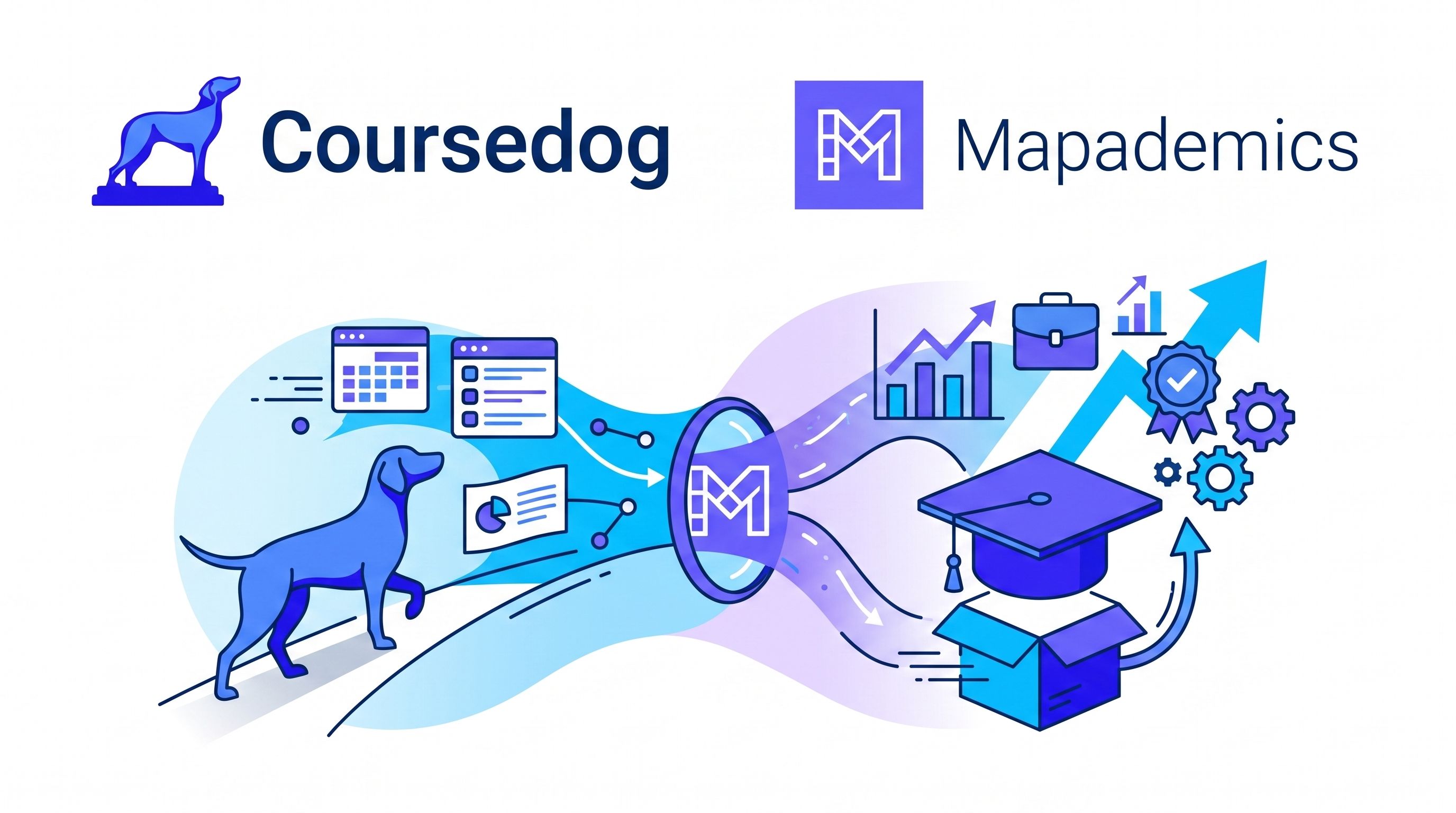
Coursedog did not build the underlying labor market data layer in-house. They partnered with Mapademics. From contract to general availability in production: under three months.
The result is the first fully native, embedded labor market experience inside a major higher-education curriculum platform — and a partnership model that demonstrates how academic operations software can move at the speed institutions actually need.
This case study covers the background of the partnership, the integration architecture, the strategic decisions that compressed the timeline, and what the launch means for the broader category of curriculum and catalog technology in higher education.
About Coursedog
Coursedog is the Intelligent Academic Operations Platform serving higher education. The platform unifies how institutions manage curriculum, catalogs, scheduling, syllabus management, assessment, and course evaluations — organized into three clouds (Curriculum Cloud, Scheduling Cloud, and Assessment Cloud) sitting on a shared intelligence layer with bi-directional integrations to every major SIS, including Ellucian, Workday, Jenzabar, Anthology, and Oracle PeopleSoft, plus LMS integrations with Canvas, Blackboard, and D2L.
Today, Coursedog serves more than 400 institutions and 3.3 million students. Customers include large research universities, community colleges, faith-based institutions, art and design schools, technical colleges, and multi-campus systems — from Brookdale Community College and Illinois Central College to Brigham Young University, Northern Arizona University, CUNY, Columbia University, and Cochise College.
Coursedog occupies a particular position in the market: it sits at the operational center of curriculum and academic decision-making. When a department drafts a new program, when a curriculum committee reviews a proposal, when a registrar publishes a catalog, when a system office coordinates across campuses — Coursedog is increasingly the system of record where the work actually happens.
That position is exactly why a partnership with Mapademics made sense for both sides.
About Mapademics
Mapademics is the skills intelligence platform for education and workforce. The platform translates curriculum, work history, and labor market activity into a common language of skills — and uses that translation to connect academic programs to careers, students to opportunities, and institutions to employer demand.
Mapademics delivers this intelligence through three primary channels: a full platform used directly by institutions, a programmatic API used by partners building integrated experiences, and a pre-built embeddable widget library compatible with major catalog and content management systems.
The partnership with Coursedog uses the API path. Coursedog's user experience is fully their own. The labor market data layer underneath is Mapademics.
The Background of the Partnership
The conversation that became the Coursedog and Mapademics partnership started from a question both companies were hearing from their customers in slightly different forms.
Coursedog's customers were asking: How do we bring workforce evidence into our curriculum decisions and our public catalog without buying yet another standalone tool?
Mapademics' customers were asking: How do we get our labor market intelligence to live inside the systems our faculty and students already use, instead of in a separate dashboard nobody opens?
Those are the same question, asked from opposite ends.
Higher education has spent more than a decade purchasing labor market intelligence as a standalone analytics product. The data has been good. The usage has been spotty. The reason is structural: workforce data lives in one place, curriculum decisions happen in another, and the cognitive cost of switching contexts means the data informs strategic moments — annual program review, board presentations, new program justifications — far more than it informs day-to-day academic operations.
The partnership emerged from a shared conviction that the right answer was not to make institutions visit a separate dashboard more frequently. The right answer was to bring the data into the workflow.
Coursedog had the workflow. Mapademics had the data layer. Both companies had customer bases that overlapped meaningfully — including community colleges, regional universities, and state-system institutions that had been asking each company, independently, for some version of what the joint product would become.
The partnership was structured to deliver three things institutions had not previously been able to buy together:
- A labor market experience that lives inside curriculum proposals and catalog pages, not adjacent to them
- A fully branded, white-labeled rendering, so the experience looks and feels like the host institution's own
- A unified data layer that stays current in real time, drawn from live job postings and continuously updated public sources
The Strategic Decision: Buy the Data Layer, Build the Experience
Coursedog's leadership evaluated three architectural paths before selecting the partnership with Mapademics:
Path 1: Build labor market intelligence in-house. Acquire raw labor market data feeds, build a skills taxonomy, build occupational mapping logic, build regional aggregation, maintain all of it on an ongoing basis. The path was technically feasible but operationally expensive. Maintaining a current skills taxonomy is a permanent engineering investment, not a one-time project. Coursedog's engineering capacity was better spent on the parts of the user experience that no other vendor could deliver.
Path 2: Embed a third-party widget. Integrate an existing labor market intelligence vendor's iframe or widget into Coursedog surfaces. The path was fast to ship but produced exactly the disjointed experience that Coursedog's design team specifically wanted to avoid. Different look-and-feel, separate authentication context, no meaningful workflow integration, and an embedded vendor logo on customers' public catalog pages.
Path 3: Build natively on a labor market intelligence API. Use a partner's API as the data layer and build the entire user experience in Coursedog's own design system. Fast to ship, deeply integrated, no visible third-party presence, and a labor market data layer maintained by a partner whose business depends on keeping it current.
Coursedog chose Path 3. They selected Mapademics.
Three factors made Mapademics the right partner for the build:
The data layer was already production-grade. Mapademics had already operationalized the hardest parts — skills extraction, program-to-occupation mapping, the unified skills taxonomy, regional labor market signal aggregation, and live job posting ingestion. Coursedog did not need to validate raw data quality from first principles or invest engineering time in problems that were already solved.
The API was composable. The Mapademics API exposes skills, occupations, labor market signals, and live job intelligence as independent endpoints — not as a monolithic dashboard SDK. That meant Coursedog could pull exactly the data needed for each surface (the proposal form, the program record, the public catalog page) and render it in their own UI, in their own design system, without inheriting anyone else's frontend assumptions.
The skills taxonomy was the shared foundation. Because Mapademics maintains a unified skills library used across multiple partners and institutions, Coursedog's customers participate in a coherent ecosystem. The skills surfaced in a Coursedog catalog page are the same skills used in employer postings, transfer evaluations, accreditation evidence, and workforce reporting elsewhere in the institution's environment.
The Integration Architecture
The Coursedog Labor Market Insights product surfaces labor market intelligence in three distinct places inside the platform. Each surface uses Mapademics API calls under the hood, rendered through Coursedog's design system and customer's branding.
Inside Curriculum Proposals
When a department chair or faculty member drafts a new program proposal in Coursedog, the proposal form now includes embedded labor market analytics: total employment, occupational outlook percentage, annual median salary, in-demand skills, and alternative job titles for SOC-mapped occupations associated with the program. The labor market context lives inside the form the proposer is already filling out.
When the curriculum committee reviews that proposal, the same evidence is present in the review interface. The committee no longer has to request workforce data as a follow-up; it is part of the proposal as submitted.
Inside Program Records
Each program in Coursedog now carries a Labor Market Analytics layer attached to its record, available to administrators across the curriculum lifecycle. The data is filterable by region — national, state, metro, or city — so an institution can see labor market context calibrated to the workforce its students actually serve.
Inside Public-Facing Catalogs
The same labor market data renders directly on public catalog program pages. Prospective students see real career outcomes — employment levels, median salaries, in-demand skills, alternative job titles, and related occupations — at the exact moment they are choosing what to study. The experience is fully branded to match the institution's existing catalog design. There is no third-party widget visible to students or families.
For institutions that want to localize further, the catalog experience supports region-specific filtering — a community college serving a particular metro can show labor market data calibrated to that metro rather than to a national average.
How the Timeline Compressed to Under Three Months
The full timeline from contract signature to production launch was under three months. That number is unusual in higher education software and is the result of specific, deliberate decisions on both sides of the partnership.
Composable API endpoints, not a one-size-fits-all SDK. Mapademics delivered endpoints Coursedog could compose against — not a packaged UI component to slot in. That meant Coursedog's product and engineering teams could move at their own pace, designing the integration to fit their workflow rather than fitting their workflow to someone else's component library.
No per-institution configuration required. The Mapademics data layer works the same way for every Coursedog customer. There was no implementation phase per institution, no school-by-school onboarding for the labor market layer. When Coursedog flipped the switch, all 400+ customers had access on the same day.
Pre-existing partnership and enablement playbooks. Mapademics had run multiple partner integrations before and had matured documentation, sandbox environments, support workflows, and enablement materials. Coursedog's team did not pay the "first integration tax" that usually slows down a new API relationship.
Aligned product philosophy. Both companies came into the partnership with the same view of what the product needed to be: native, embedded, branded, and useful day one. There was no architectural debate about whether to use iframes, no design tension about visible partner attribution on customer pages, no scope creep about features that would have delayed the launch. The partnership moved fast in part because it didn't have to argue with itself.
The result: a brand-new product line, a brand-new data layer, embedded across three core surfaces of an existing platform, shipped in less than a quarter, available to every customer on day one.
What Coursedog Customers Got at Launch
Five capabilities went live with Coursedog Labor Market Insights in May 2026:
- Embedded Labor Market Data inside program proposals and program records — total employment, occupational outlook, median salary, in-demand skills, alternative job titles, by SOC occupation
- Curriculum Workflow Integration that incorporates labor market evidence into proposal, review, and approval flows without manual export or re-keying
- Program-to-Career Mapping using standardized SOC occupations, providing defensible justification for curriculum decisions
- Catalog Career Outcomes Display surfacing the same labor market context directly on public catalog program pages
- Localized Insights filterable by region, state, metro, or city — calibrated to the institution's actual labor market
Each capability is rendered through Coursedog's native UI and powered by a Mapademics API call underneath. The customer experience is Coursedog. The data layer is Mapademics. Both are designed to feel like one thing.
What This Means for the Curriculum Software Category
The Coursedog launch sets a new baseline for the category. For roughly a decade, "we have labor market data" has been a marketing claim in higher education software — usually delivered as a separate analytics product, a sidebar widget, or a partner referral. The Coursedog Labor Market Insights launch is the first time a major curriculum vendor has shipped a fully native, embedded, branded experience at this scale.
The implication for institutions evaluating curriculum and catalog vendors is straightforward. Workforce alignment is now a procurement criterion in most RFPs we encounter, and the question of where the labor market data lives in a product is increasingly outcome-determining. Vendors that cannot match an embedded, branded, real-time labor market experience are starting to lose competitive evaluations on that line item alone.
The implication for other vendors in the ecosystem is also straightforward: the data layer that powered the Coursedog launch is available. Mapademics offers two clean paths — the API (the path Coursedog took, for vendors that want to build native experiences in their own design systems) and the pre-built embed widget (compatible with all major catalog and content management platforms, for vendors or institutions that want to ship without building).
What's Next
The May 2026 launch is the first iteration. Coursedog has a roadmap of additional features built on the same Mapademics API, including expanded skills capabilities that the underlying API already supports — skills extraction from syllabi and course descriptions, program-to-occupation alignment with transparent skill-level evidence, course-level skills mapping for stackable credentials and curriculum gap analysis, and live job intelligence with employer-level signal.
Coursedog now owns the foundation. Everything on the expansion path is paved on the same partnership.
Mapademics is proud to be the data layer behind that work, and we expect this to be the first of many integrations of this depth across the higher education software ecosystem in the next 24 months.
Lessons Worth Pulling Out
A few patterns from the engagement worth noting for institutions evaluating similar capabilities and for other vendors considering similar partnerships:
Embedded beats adjacent, every time. A labor market dashboard your users have to visit is fundamentally different from labor market data that lives where your users already work. The Coursedog experience is the latter, and the usage numbers reflect it.
Branded matters. Labor market intelligence presented through a third-party widget signals to students and faculty that the data is external — something the institution is referencing, not something it owns. Branded, native presentation signals the opposite. The institution is making the workforce claim, with the data as evidence.
The right partnership compresses time. Coursedog could have built this in-house over two to three years. They chose to ship it in three months on top of a partner's data layer, and the resulting product is the category-defining example. The build-vs-partner decision is one of the most consequential architecture decisions a product leader makes; this one is worth studying.
Make it available to everyone at launch. Coursedog made Labor Market Insights available to every customer at launch, not as a paid upgrade tier. That decision is part of why the product is becoming the category benchmark. Embedded value compounds with reach.
Two Paths to the Same Data Layer
Institutions and vendors interested in equivalent capability have two clean options through Mapademics:
The Mapademics API. Programmatic access to skills extraction, program-to-occupation mapping, the Mapademics Skills Library, real-time labor market signals, and live job intelligence. The path Coursedog used. Right for partners with engineering capacity who want a fully native, fully branded experience.
The Mapademics Embed Widget. A pre-built, brandable widget compatible with all major catalog and content management systems in higher education. Right for institutions or vendors that want labor market intelligence on their catalog pages without building a custom integration. Typical time-to-live is days, not months.
Both options expose the same underlying skills library and labor market signal layer. Many partners use both — widgets for fast deployment on public-facing pages, API for deeper workflow integration in operational tools.
Get in Touch
If you are an institution interested in bringing labor market intelligence into your catalog, your curriculum process, or your student-facing experience — or a vendor considering an integration similar to the one Coursedog built — we would love to start a conversation.
Mapademics is the skills intelligence platform for education and workforce. We translate curriculum, work history, and labor market activity into a common language of skills — and we make that language available wherever academic and career decisions are being made.