
Labor Market Data Needs a Skills Layer
Wages and openings describe the market. They can't show whether a program prepares students for it. Here is what skills extraction adds for any platform that puts programs next to jobs, and why Workforce Pell makes it urgent.
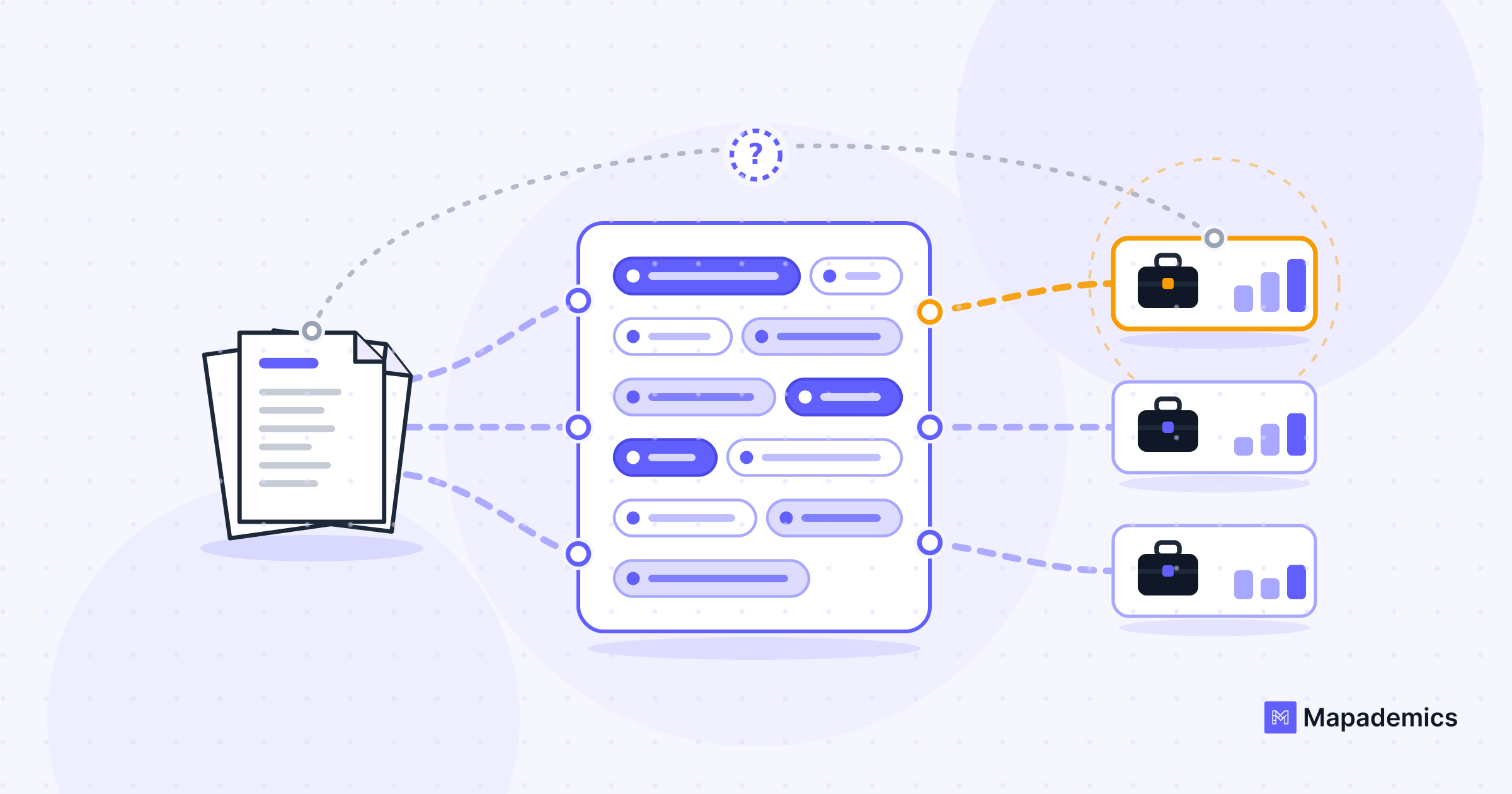
Pull up two computer science programs on almost any labor market dashboard and they look identical. Same occupations. Same median wages. Same projected growth. One program requires three semesters of software engineering and a capstone with an industry client. The other is mostly theory. The dashboard can't tell them apart, because it never looked at either curriculum.
The wage and demand figures are accurate. What's missing is any view of what the programs teach. That is the gap skills extraction closes.
The crosswalk was built for categories, not courses
Most labor market products connect a program to jobs through the CIP-SOC crosswalk, a joint product of the National Center for Education Statistics and the Bureau of Labor Statistics. It matches six-digit instructional program codes to six-digit occupation codes. Agency staff built the mappings from expert knowledge and public research, and each link records a direct relationship: programs in that category provide knowledge and skills that apply to the occupation (NCES crosswalk guidelines).
That makes it a well-built national reference. It also means the crosswalk describes what a program category should prepare students for. It says nothing about what one program at one institution teaches. Every program with the same code inherits the same occupations, whether or not its courses build the skills those occupations require.
Platforms built on the crosswalk were working with what was available. The curriculum itself has always lived in syllabi, course descriptions and learning outcomes, written in thousands of formats and vocabularies. None of it was structured enough to compare against a job. So the market side of the picture became precise and current, and the program side stayed a code.
Workforce Pell turns alignment into something institutions must prove
For years, closing that gap was a nice-to-have. Now it carries federal dollars. The Department of Education's final rule on Workforce Pell, published May 19, 2026 and effective July 20, 2026, sets the terms for Pell Grants in short-term programs. Its requirements ask for exactly the evidence that labor market data alone can't supply (ACTE summary; AIR summary):
- Length. Programs must run 150 to 599 clock hours, over at least 8 and fewer than 15 weeks.
- Occupational alignment. Governors, working with state workforce boards, identify high-skill, high-wage or in-demand occupations and approve the programs that prepare students for them.
- Stackability. The credential must stack into a higher-level, credit-bearing program, and states must verify that articulation in writing.
- Outcomes. 70 percent of students must complete, and 70 percent of completers must be employed in the second quarter after they finish. Tuition can't exceed the program's value-added earnings.
- Placement in field. After a transition period, placement is measured by employment in the occupation the program prepares students for, or a comparable one.
Read that list as a product requirement. A governor's office reviewing a program wants to see which occupations it serves and why. A state verifying stackability wants to see how the short-term program connects to the degree it feeds. An institution watching its placement rate wants to know, before the cohort graduates, whether the curriculum covers what employers in the target occupation hire for. A CIP code can't answer any of those questions. A skills analysis of the curriculum can.
Approval also isn't permanent. States must review their determinations at least every two years, and programs that miss the completion, placement or earnings thresholds lose eligibility (AIR). The evidence has to be repeatable, program by program, year after year.
What Mapademics Skills Extraction adds
Mapademics Skills Extraction reads the curriculum documents institutions already have and turns them into structured, comparable skills data. It is available through the Mapademics API, so a platform can add a skills layer without building one.
Extract: documents in, skills out
Submit a syllabus, a course description or a set of learning outcomes. The engine identifies explicit and implied skills from the surrounding language and returns each one with a proficiency level and a written justification tied to the source. An Advertising Strategy syllabus, for example, returns Audience and User Insight Integration at the top proficiency level, because assignments such as "Target Audience" and "Media Strategy" require students to apply audience research to real decisions. Average turnaround for a curriculum document is under 10 seconds (Skills Extraction & Translation).
Normalize: one skills language
Every extracted skill maps to the Mapademics Skills Library: 500+ deduplicated skills across 30+ domains, maintained from real-world signals in syllabi, resumes and job descriptions. A skill pulled from a syllabus carries the same meaning as the same skill pulled from a job posting. That shared definition is what makes a program and an occupation comparable.
Match: programs against occupations and demand
Program skills are scored against the skills each occupation requires, then paired with labor market data covering 900+ occupations, all 50 states and 10+ years of wage and growth history. The job list a platform already shows becomes a ranked set of matches, each with its reasons attached.
The reports a skills layer makes possible
Once a platform has skills data for a program, several analyses that used to be one-off projects become standard features:
- Program-to-occupation alignment by region. Match scores for each related occupation, paired with wages, openings and growth for the state or region the institution serves.
- Skills coverage and gap analysis. Which of an occupation's required skills a program covers, how deeply, and which ones no course teaches at all.
- Student pathway alignment. Which course in a pathway builds each skill, and to what level, so students and advisors can see how the sequence adds up to a career.
- Program skills summaries. Top skills and proficiency by program, grouped by domain, ready for catalog and program pages.
- Proposal and grant justification. Documentation for new programs, grants and Workforce Pell approvals, with labor market alignment and occupational linkages written out.
Each one traces back to specific syllabi and specific assignment language. When a reviewer asks why a program matches an occupation at 83 percent, the answer is a list of skills and the documents they came from.
Where it fits in a platform
The API exposes the same skills data, alignment logic and labor market signals that power the Mapademics platform, across 25+ endpoints (Integrations & API). Platforms typically use it one of three ways:
- Raw data. Call the API and render skills, matches and gaps in your own interface and design system.
- Embedded views. Drop in Mapademics widgets or published reports where building a new screen isn't worth it.
- Exports. Pull structured skills and alignment data into reporting, compliance or approval workflows.
It fits any product that puts programs next to jobs: student information and CRM systems, advising and career platforms, workforce board tools, and state or system dashboards.
What it doesn't do
The first question most platform teams ask is whether this replaces their interface or their data. It doesn't. Skills extraction sits between the curriculum and the labor market figures a platform already displays. It doesn't ask institutions to rewrite syllabi into a template, because it reads documents as they are. And it doesn't make curriculum decisions. Every extracted skill arrives with its justification, so faculty and staff can review what was captured, and the institution decides what to change.
What changes for the people using it
For a workforce dean assembling a Workforce Pell packet, the evidence for occupational alignment and stackability comes out of a report instead of being assembled by hand. For a curriculum committee, a new program proposal arrives with its target occupations and skill gaps already scored. For a student comparing two programs with the same code, it's the first real look at which one teaches what the job asks for.
A match score is only as useful as the evidence behind it. Skills extraction puts that evidence in the curriculum itself.
Build it or plug it in
A platform could build this layer itself. It would need a maintained skills taxonomy, extraction models that handle every syllabus format in higher education, an occupation-matching layer, a labor market pipeline, and a standing team to keep all four current. Mapademics built the skills library, the extraction engine, the matching logic and the labor market data as one product, so a platform can add all of it through a single integration instead of stitching together a stack.
Labor market data was the first step toward showing where programs lead. Skills are the second. With Workforce Pell asking institutions to prove alignment program by program, the platforms that can show the evidence are the ones institutions will depend on.
Building a product that shows programs next to jobs? See how the Mapademics API adds skills extraction, occupation matching and gap analysis to it. Reach out at mapademics.com.
Sources: U.S. Department of Education, Workforce Pell final rule, 91 FR 29254 (May 19, 2026); ACTE, ED Releases Final Rule on Workforce Pell (May 18, 2026); American Institutes for Research, Workforce Pell: Expanding Access to Short-Term Job Training (May 13, 2026); NCES, CIP SOC Crosswalk and crosswalk guidelines (March 2020); Mapademics platform pages for Skills Extraction & Translation, Skills Library, Labor Market Intelligence and Integrations & API.