
Transfer Credit Is a Systems Problem. It Needs a System-Level Fix.
Accreditors, states, and systems are being asked to standardize transfer evaluation across institutions that have never shared a common framework. Here is how Mapademics helps them build one — and make it portable across state lines.
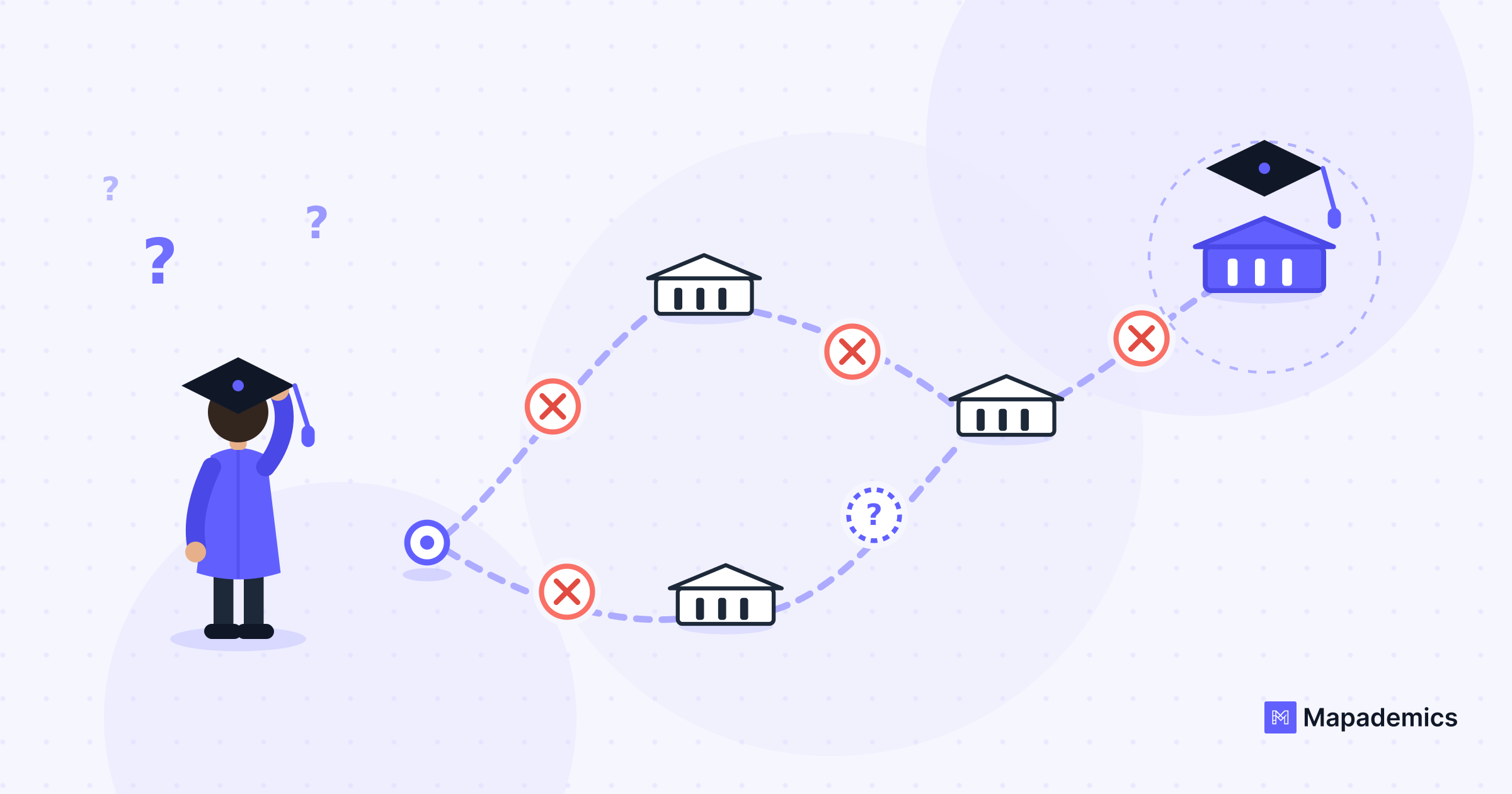
A student finishes two years of coursework, does the work, earns the grades, and transfers. Then roughly two of every five credits they earned simply disappear. That is not a metaphor: the U.S. Government Accountability Office found that students who transfer lose an average of 43 percent of the credits they have already earned. More than a third of undergraduates transfer at least once, and roughly 38 million Americans now carry college credit with no credential to show for it.
Every one of those numbers describes the same failure. The credit was earned, the learning happened, and the system could not carry it across an institutional boundary. What is changing right now is who is being asked to fix it.
Transfer evaluation was never designed. It accumulated.
There is no national transfer standard, and in most places barely a statewide one. What exists instead is bilateral articulation agreements negotiated one pair of institutions at a time; state compendium tables that cover public institutions inside one state and stop cold at the border; registrar-led manual review driven by course titles rather than by what a course actually teaches; and institutional discretion that accreditation standards have historically left almost entirely unconstrained.
Each piece is defensible alone. Together they produce a system that is fragmented, decentralized, slow, and — critically — not portable. An equivalency painstakingly established between two colleges in one state carries no weight for the third college in the next state, even when the coursework is identical. This is a structural problem, not a bad-actor problem: institutions built it incrementally, with no shared framework to build against.
A federal floor is coming, and accreditors are moving first
In May 2026, the U.S. Department of Education's Accreditation, Innovation, and Modernization (AIM) negotiated rulemaking committee reached consensus on new federal requirements for transfer of credit. Institutions would be expected to presume that undergraduate credit transfers when coursework at another accredited institution has comparable content and learning outcomes, unless they can produce a written, student-specific rationale for denying it — plus new disclosure obligations covering what will transfer, why anything was denied, and what replacing it costs. A final rule is targeted for November 1, 2026, effective July 1, 2027.
Accreditors are not waiting. In July 2026, SACSCOC announced the Transfer Credit Consortium, a voluntary, faculty-led partnership in which member institutions establish shared learning outcomes and academically sound course equivalencies, starting with general education. As of SACSCOC's own late-July update, 195 institutions had joined the effort to build the framework.
The draft framework SACSCOC describes publicly is instructive, because it is easy to write and very hard to operate: a 90 percent credit-acceptance floor between member institutions, a publicly posted and annually updated equivalency guide, a 30-day evaluation timeline with written explanations for any credit not accepted, a formal appeals process, and non-discrimination protections.
Read that as an operations problem rather than a policy one. No registrar's office in America is staffed to refresh a public equivalency guide across hundreds of institutions, turn evaluations in thirty days with written justifications, and keep a record defensible enough to survive an appeal. That gap — between a standard that has been written and a process that can execute it — is where Mapademics works.
What Mapademics provides
Mapademics reads what institutions already publish — public catalogs, syllabi, learning outcomes, curriculum maps, assessment reports — and extracts the skills underneath. Not course titles. Not credit hours. The actual competencies a course teaches, normalized to a shared taxonomy so a course at one institution can be compared to a course at another on substance rather than nomenclature. For an accreditor, state agency, or system office, that shows up in three ways.
1. A framework for the standards themselves — portable across state lines
Before anyone evaluates a single transfer, somebody has to answer a harder question: what counts as equivalent? Historically each institution answered that privately, which is exactly why the answers do not travel.
Mapademics provides the shared substrate that makes a common answer possible: a normalized skills taxonomy underneath every participating institution's curriculum, so equivalency is defined once, in terms of demonstrable learning, and applied consistently everywhere. Two consequences are worth separating.
- It standardizes. Accreditors, state systems, governing boards, and consortia define equivalency criteria against a single framework rather than several hundred local conventions. Faculty still make the academic judgment — the framework gives them a common object to judge.
- It ports. Because the framework is grounded in skills rather than one state's course-numbering scheme, an equivalency established inside one system stays meaningful outside it. State compendiums structurally cannot do this. Students cross state lines constantly — military families, athletes, adult learners, online students — and the framework has to move with them.
We have already built this at state scale. Every course in the Alabama Community College System is mapped to skills and occupations, built from public catalog data and the state's existing course-to-course transfer file — no SIS integration, no procurement cycle, no cost to the colleges for catalog-level reports.
2. The analysis itself
A framework nobody can run against real curriculum is a white paper. Mapademics also does the evaluation work: transcript extraction, course matching against the originating institution's actual catalog, semantic course-to-course equivalency matching, and a transfer report tying it together. Every match carries a score and the evidence behind it — the specific skills driving the match and the specific skills breaking it — so a faculty reviewer approves a recommendation with a rationale attached rather than starting from a blank page.
Three properties matter at system or accreditor scale.
- No institutional cooperation is required for coverage. Because we read publicly available catalog data, coverage does not depend on who has opted in or finished an IT project. That is what makes region-wide and multi-state analysis feasible at all.
- Faculty stay in control. The engine proposes; faculty dispose. Reviewers approve, decline, or condition each match, and approved pathways are stored so the same question is never answered twice.
- It handles the messy cases. Coursework taken decades ago, credit for prior learning, programs renamed or restructured — the cases that consume the most registrar time are the ones title-matching handles worst.
3. The portal — transparency, history, and prediction
Standards and analysis both need somewhere to live. The Mapademics transfer portal gives a commission, state agency, system office, or individual institution one place to:
- Look up an articulation instantly — course to course, program to program, institution to institution — instead of emailing a registrar and waiting.
- Track articulation agreements over time. Equivalencies are dated and versioned, so you can see what was true when a student enrolled, not only what is true today. That record is what makes a written denial rationale or an appeal defensible.
- Publish transparently. A public, annually updated equivalency guide stops being a fire drill and becomes a live view.
- Predict pathways. Because the underlying data is skills-based and comprehensive, you can identify which transfer pathways between which institutions will be cleanest for students — and where the friction concentrates — before a student ever commits.
That last capability changes planning rather than just processing. A system office can see where credit loss is structurally concentrated and go fix the framework, instead of discovering the problem one appeal at a time.
A new standard for students, not just for institutions
All of that is infrastructure. The point of it is the student experience, and the standard now within reach is simple to state and has been nearly impossible to deliver:
A student should know what will transfer before they enroll, understand why anything was denied, and be able to appeal it.
That is close to what the coming federal rule will require and what the SACSCOC draft framework describes — and it is unachievable through manual review at scale. A 30-day clock with written justifications is a data problem long before it is a staffing problem.
Training and webinars
New standards fail on adoption, not on design. The people who live inside a transfer framework — registrars, transfer coordinators, department chairs, faculty content experts, institutional effectiveness staff — determine whether it works.
Mapademics will provide training programs and a webinar series to support institutions and systems adopting these new standards: how skills-based equivalency works and how to read the evidence behind a match, how faculty review workflows operate, how to prepare for the disclosure and timeline obligations arriving in 2027, and how to use the portal for system-level planning. Where a consortium, state agency, or accreditor is standing up its own framework, we build the enablement around that framework rather than around a generic product tour.
Why this costs dramatically less than the alternative
The conventional way to assemble this capability is to buy three or four things and pay someone to make them talk to each other: a labor market data provider (typically $20,000–$50,000 per year on its own), a skills and standards analysis engine, a transfer or articulation platform, and a reporting layer on top — plus integration work, usually the largest line item and the one that never quite finishes.
Mapademics is all four in one system. The data provider, the analysis engine, the transfer platform, and the reporting layer are the same product, built together, with labor market data included rather than licensed separately. There is no integration project because there are no seams, and no IT lift for the institution, because the primary input is public catalog data they have already published. That is the structural reason the economics are different. It is not a discount on a stack. It is one system instead of a stack.
Special pricing for nonprofit and government
Mapademics offers dedicated pricing for nonprofit institutions and government entities, including volume pricing for accreditors, state agencies, higher education systems, and consortia. If the goal is to give every member institution access to a shared framework, pricing should not turn participation into a budget decision at each campus.
Where this goes
Transfer credit has been one of higher education's most expensive solvable problems for decades. What has changed is that the sector now has both a reason to move — a federal floor arriving in 2027 — and, for the first time, the means to build something better than a compendium table. The systems that do this well will not be the ones that write the best policy document. They will be the ones that can operate it: standards that are portable, analysis that runs at scale with faculty in the loop, and a portal that makes the whole thing transparent and auditable.
Talk to us. If you are an accreditor, state agency, system office, or consortium working on transfer standards, we would like to hear what you are building. Reach out at mapademics.com.
Sources: U.S. Government Accountability Office, GAO-17-574; SACSCOC, SACSCOC Launches National Initiative to Boost Transfer of Credit between Member Institutions; SACSCOC, In the Room: The Case for a Credit Transfer Consortium; U.S. Department of Education, AIM negotiated rulemaking consensus, May 2026.